Table of Contents
ToggleQuality outdoor furniture isn’t cheap, and leaving it exposed to UV rays, rain, and dirt shortens its lifespan dramatically. Covers made from Sunbrella fabric have become the go-to solution for serious homeowners who want their patio sets, grills, and loungers to last more than a few seasons. Unlike generic polyester tarps that crack or fade within a year, Sunbrella’s solution-dyed acrylic holds up against sun, moisture, and mildew, qualities that make a measurable difference in furniture longevity. This guide walks through what sets Sunbrella apart, how to match covers to furniture shapes, and whether the higher price tag actually pays off over time.
Key Takeaways
- Sunbrella patio furniture covers use solution-dyed acrylic that resists UV fading, mildew, and moisture far better than generic polyester tarps, extending outdoor furniture lifespan to 10+ years.
- Proper sizing is critical to prevent cover failure—measure furniture dimensions, add 2–4 inches for drape, and choose form-fitting designs for irregular shapes like egg chairs or Adirondacks.
- While Sunbrella covers cost $50–$200+ upfront, they average around $17/year over a 7-year lifespan, often beating cheaper alternatives when accounting for furniture preservation costs.
- Installation and maintenance require sweeping debris beforehand, ensuring proper ventilation to prevent condensation, anchoring covers securely in high-wind areas, and air-drying completely before storage.
- Routine cleaning with a soft brush and mild soap keeps Sunbrella covers fresh, while mildew-prone humid climates benefit from periodic vinegar rinses and quarterly inspections for trapped moisture.
- Sunbrella’s reinforced double-stitched seams and bar-tack stitching at stress points prevent ripping where budget covers routinely fail, making it the benchmark for serious outdoor furniture protection.
Why Sunbrella Fabric Is the Gold Standard for Outdoor Furniture Protection
Sunbrella’s reputation comes from its solution-dyed acrylic construction, where pigment is added during fiber production rather than applied as a surface coating. This process locks color into the fiber itself, so UV exposure won’t bleach or fade the material the way it does with printed or coated fabrics.
The fabric’s water-resistant finish repels moisture without creating the clammy condensation trap common in vinyl covers. Water beads up and rolls off rather than soaking through, which prevents mold and mildew from establishing colonies on the furniture underneath. The material also breathes, allowing trapped moisture from humidity or light rain to evaporate instead of fostering rot on wood frames or corrosion on metal.
UV resistance is measured in the fabric industry using a standard called the AATCC Test Method 16, which tracks colorfastness under accelerated sun exposure. Sunbrella fabrics consistently score above 1,500 hours before noticeable fading, compared to 200–400 hours for standard polyester.
These covers typically weigh between 8 and 10 ounces per square yard, providing enough heft to resist tearing from wind without being so heavy that they’re cumbersome to handle. Reinforced double-stitched seams and bar-tack stitching at stress points, especially around grommets and tie-down loops, prevent ripping where cheaper covers routinely fail.
Another practical advantage: the fabric resists mildew growth even in humid climates. While no fabric is entirely mildew-proof if left wet and bunched up for weeks, Sunbrella’s chemical treatment and quick-dry properties keep spore colonization to a minimum. Homeowners in the Southeast or Pacific Northwest see this benefit most clearly, as garden design experts often recommend breathable, mildew-resistant materials for damp outdoor environments.
Types of Sunbrella Patio Furniture Covers for Every Outdoor Setup
Sunbrella covers come in form-specific styles, not one-size-fits-all tarps. Matching cover type to furniture shape prevents sagging, water pooling, and wind damage.
Dining set covers are designed for table-and-chair groupings. Look for models with drop lengths (vertical measurement from tabletop to ground) between 24 and 30 inches, which fully enclose chair backs and legs. Some designs include ventilation panels near the base to prevent wind from turning the cover into a sail.
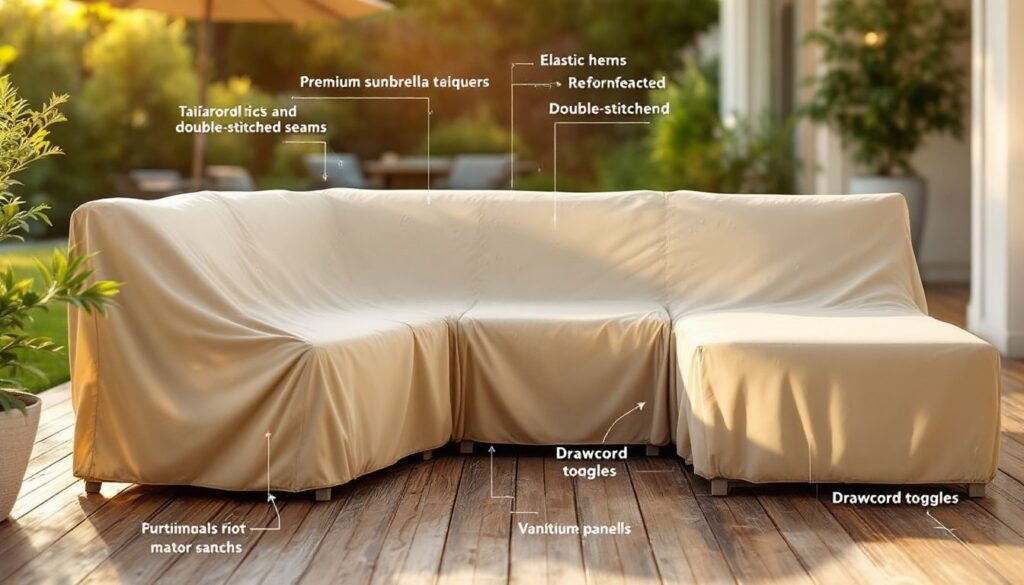
Sectional and modular sofa covers use L-shaped or U-shaped patterns to fit corner configurations. These typically feature elastic hems with drawcord closures at the base to cinch around furniture legs, keeping the cover snug during storms. Modular covers can be zipped together for flexible configurations.
Lounge chair and chaise covers need extra length, often 80 to 90 inches, to accommodate reclined positions. Many include a split-leg design at the foot end to fit around adjustable frames without bunching.
Fire pit and heater covers prioritize heat-resistant liners and reinforced venting. Never cover a fire feature or heater until it’s completely cool: even Sunbrella fabric will melt if placed over residual heat.
Grill covers require grease-resistant coatings and higher sidewalls (40+ inches for many stand-up grills). Side pockets for tool storage are a common feature, though they can collect debris if not emptied regularly.
Umbrella covers are tall and narrow, with a zippered side closure that wraps around the pole. Measure your umbrella’s canopy diameter when closed (typically 6 to 11 feet) before buying: an oversized cover will flap and fray.
For odd-shaped furniture or built-in seating, outdoor furniture specialists often recommend custom-fit Sunbrella covers, which are sewn to exact dimensions and typically cost 30–50% more than off-the-shelf options but eliminate fit issues entirely.
How to Choose the Right Size and Fit for Your Furniture
Improper fit is the most common reason covers fail prematurely. A cover that’s too small tears at seams: one that’s too large collects water and blows away.
Start by measuring length, width, and height of the furniture at its widest and tallest points. For sectionals, measure the entire assembled footprint, not individual pieces. Add 2 to 4 inches to each dimension to allow for a slight drape without excessive fabric pooling on the ground.
Seat height vs. back height matters for seating covers. Measure from the ground to the tallest point, usually the top of the backrest. Most patio chair backs range from 32 to 42 inches: dining chair covers often stop short at 36 inches, which leaves taller backs exposed.
Tables with umbrella holes require covers with a center grommet or zipper so the umbrella pole can stay in place. If you remove the umbrella for winter, a solid cover without the opening works fine and sheds water better.
For irregular shapes, like Adirondack chairs with wide arms or egg chairs with curved frames, look for covers labeled “contoured” or “form-fitting.” Generic rectangular covers bunch awkwardly on these designs.
Attachment systems vary:
- Elastic hems stretch around furniture bases: they work well for lightweight pieces but can lose tension over time.
- Drawcords with barrel-lock toggles offer adjustable tightness and hold up better long-term.
- Buckle straps connect under the furniture, anchoring the cover against wind. These are common on higher-end models.
- Tie-down grommets let you stake the cover to the ground or deck using bungee cords or rope, essential in high-wind areas.
If the furniture has removable cushions, store those separately indoors or in a deck box. Covering cushions outdoors traps moisture inside the foam, leading to mildew even under a breathable Sunbrella cover.
Installation and Maintenance Tips for Long-Lasting Coverage
Putting a cover on correctly takes five minutes but prevents hours of repair or replacement down the line.
Before covering, sweep off loose dirt, leaves, and debris from furniture surfaces. Dirt left under the cover acts like sandpaper, wearing through fabric from the inside out. For wood furniture, check that any finish or sealant is fully dry: trapping solvents under a cover can cause discoloration.
Ventilation is critical. Even breathable Sunbrella fabric needs airflow to prevent condensation. Don’t seal covers so tightly that air can’t circulate. On calm days, crack the cover slightly or use built-in vents. In humid climates, consider propping furniture up slightly on rubber furniture risers (available at hardware stores for $5–10 per set) to create an air gap underneath.
Anchor the cover properly. In areas with sustained winds above 20 mph, use bungee cords looped through grommets and tied to deck anchors or furniture legs. For decks without anchor points, sandbag weights or water-fillable anchor bags placed on the cover’s lower hem provide stability without drilling.
Don’t leave covers on year-round without periodic inspection. Lift the cover every 4–6 weeks to check for trapped moisture, insect nests, or debris accumulation. This is especially important after heavy storms.
Caring for Your Sunbrella Covers: Cleaning and Storage Best Practices
Sunbrella fabric is machine-washable, but read the care tag first, some models with waterproof linings shouldn’t go in a standard washer.
For routine cleaning, brush off loose dirt with a soft-bristle brush, then hose down the cover while it’s still on the furniture. For stubborn stains (tree sap, bird droppings, pollen), mix ¼ cup mild dish soap in a gallon of warm water and scrub with a sponge. Rinse thoroughly: soap residue attracts dirt.
Mildew spots respond to a solution of 1 cup white vinegar + 1 gallon water, applied with a spray bottle and left for 15 minutes before rinsing. For persistent mildew, Sunbrella’s manufacturer recommends a diluted bleach solution (1 cup bleach per gallon of water), though this should be a last resort as repeated bleach exposure can weaken fibers over time.
Never put covers in the dryer. Air-dry completely before folding and storing, as home maintenance guides consistently emphasize that even slightly damp fabric stored in a closed space will mildew within days.
When storing covers off-season, keep them in a breathable storage bag or bin, not a sealed plastic tote. A mesh laundry bag or the original packaging works well. Store in a dry garage, shed, or basement, off the ground to avoid moisture wicking from concrete.
PPE for cleaning: Wear rubber gloves when handling bleach or vinegar solutions and work in a ventilated area.
Cost Comparison: Are Sunbrella Covers Worth the Investment?
Sunbrella covers cost significantly more than generic alternatives, often $50 to $200+ depending on size, compared to $20–60 for basic polyester models. The question isn’t just upfront cost but cost per year of usable life.
A typical budget polyester cover lasts 1–2 seasons before UV exposure causes brittleness, seam failure, or fading. At $30 per cover replaced every 18 months, that’s roughly $20/year.
A quality Sunbrella cover, with proper care, lasts 5 to 10+ years. A $120 cover used for seven years costs about $17/year, slightly less than the cheap option, with better protection throughout.
The bigger savings come from furniture preservation. Outdoor sectionals, teak dining sets, and wrought-iron pieces easily cost $1,000–5,000+. Unprotected furniture exposed to full sun and rain may need refinishing, cushion replacement, or structural repair within 3–5 years. Covered furniture regularly lasts a decade or more with minimal maintenance.
Regional factors matter. In the arid Southwest, UV degradation is the primary threat, and Sunbrella’s colorfastness pays off quickly. In the rainy Pacific Northwest or humid Southeast, mildew resistance is the key benefit. In coastal areas, salt spray and high winds make tear-resistant, reinforced stitching essential, another Sunbrella strength.
For seasonal-use furniture, pieces only out from May to September, even a cheaper cover may suffice if the furniture is stored indoors the rest of the year. For year-round outdoor setups, Sunbrella’s durability and weather resistance become non-negotiable.
Warranty is another consideration. Many Sunbrella covers carry 3- to 5-year limited warranties covering defects in materials and workmanship, though UV fading and normal wear aren’t typically covered. Budget covers rarely include any warranty at all.
Conclusion
Sunbrella patio furniture covers deliver measurable protection through solution-dyed acrylic fabric, reinforced construction, and proven resistance to UV, moisture, and mildew. Choosing the right type and size, securing covers properly, and maintaining them with periodic cleaning extends both the cover’s lifespan and the furniture underneath. While the initial cost is higher than generic alternatives, the per-year expense often works out favorably, especially when factoring in the cost of replacing or refinishing unprotected furniture. For homeowners committed to preserving outdoor investments, Sunbrella remains the benchmark.