Table of Contents
ToggleSmall decks are deceptive. They promise outdoor living space but leave many homeowners staring at an awkward 8×10-foot slab, wondering how to fit seating, a grill, and maybe some plants without creating a furniture obstacle course. The problem isn’t the deck size, it’s the approach. Most people buy standard-sized patio sets, shove them against the railing, and call it done. The result? Cramped, unusable space that feels even smaller than it is. Arranging furniture on a small deck requires intentional planning, scaled pieces, and layout strategies that maximize every square foot while maintaining flow and function.
Key Takeaways
- Measure your deck and map traffic flow before buying furniture—leaving 24–30 inches for walkways and 36 inches of clearance at doors prevents costly mistakes when arranging patio furniture on a small deck.
- Choose apartment-sized or bistro-scale pieces with visible legs, open frames, and multi-functional designs like storage benches and nesting tables instead of standard-sized furniture that wastes precious space.
- Create defined zones for one primary and one secondary activity, float smaller pieces inward instead of lining edges, and use corner seating like L-shaped benches to maximize usable space without a cluttered layout.
- Leverage vertical space with hanging planters, wall-mounted tables, and tiered plant stands to keep the deck surface clear and free up room for actual seating and movement.
- Employ visual tricks like light colors, continuous furniture lines, limited color palettes, and properly-sized outdoor rugs to make your small deck feel larger and more intentional.
- Install retractable shade sails or privacy screens on walls rather than using floor-standing umbrellas, and consider drop-leaf or extendable tables to add flexibility without permanently consuming deck space.
Measure Your Deck and Plan Your Layout First
Before dragging furniture outside, measure the deck dimensions and note any fixed obstacles. Homeowners often skip this step and end up returning oversized furniture or blocking door swings.
Start by recording the deck’s length and width in feet and inches. Mark the location of doors, railings, stairs, support posts, and any built-in features like planters or benches. If the door swings outward onto the deck, leave a 36-inch clearance zone, walking through a cracked-open door because a chair’s in the way gets old fast.
Next, map out traffic flow. Identify the primary walkway from the door to the stairs or most-used area of the deck. This path should remain at least 24 to 30 inches wide, narrow enough to save space, wide enough to carry a tray of drinks without hip-checking a table.
Draw a scaled layout on graph paper or use a free deck planner app. Each square can represent one square foot. Cut out paper templates of furniture pieces at the same scale and move them around. This low-tech method prevents the expensive mistake of buying a loveseat that technically fits but kills all usable space around it.
Consider the deck’s orientation and sun exposure. If the west side gets blasted by afternoon sun, that’s probably not where seating should go unless shade is part of the plan. Note views worth preserving and eyesores worth blocking.
Choose the Right Furniture Scale and Pieces
Standard patio furniture is built for sprawling suburban decks, not compact spaces. A typical sectional sofa runs 80 to 100 inches long, half the width of many small decks. Choosing appropriately scaled pieces is non-negotiable.
Apartment-sized or bistro-scale furniture is the baseline. Look for loveseats instead of full sofas (48 to 60 inches versus 72+ inches), armless chairs that tuck under tables, and tables with diameters of 30 to 36 inches instead of 48-inch rounds. Every six inches saved on furniture width translates to usable floor space.
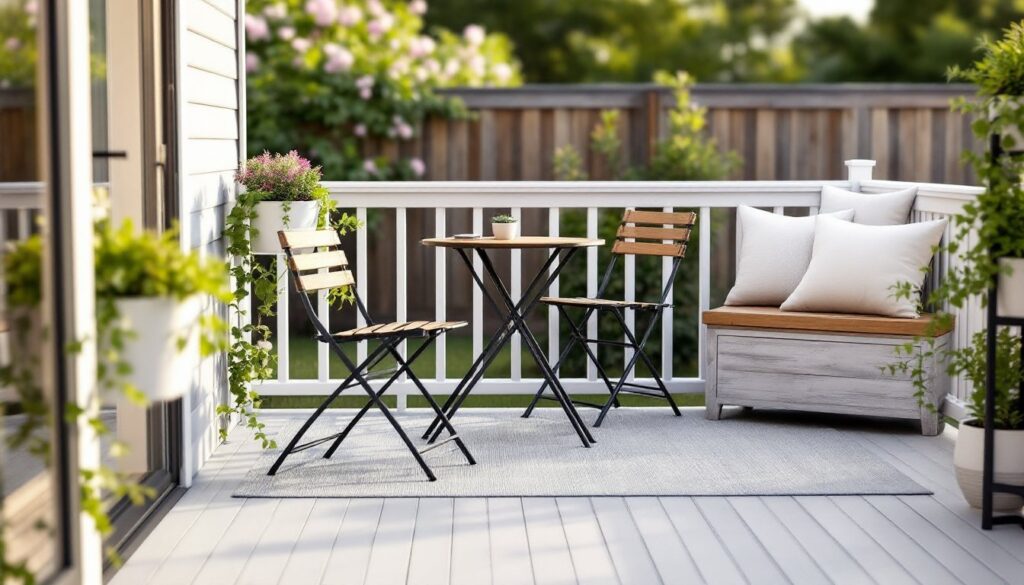
Prioritize multi-functional pieces. An outdoor storage bench provides seating and hides cushions or grilling tools. Nesting side tables stack when not needed. Folding chairs hang on wall-mounted hooks when guests leave. These aren’t compromises, they’re intentional choices for small-space living that echo strategies used in apartment-scale design.
Furniture legs and frames matter more than most realize. Pieces with visible legs and open frames create sight lines to the deck surface, making the space feel less cluttered. Solid-skirted furniture, sofas with bases that run to the ground, visually shrinks a deck. Opt for metal or wood frames with at least 4 to 6 inches of clearance underneath.
Skip the deep-seat lounge chairs unless lounging is the deck’s sole purpose. They eat 36+ inches of depth and make conversation seating nearly impossible on a compact deck. Standard-depth seating (20 to 24 inches) is more versatile.
If the deck will host meals, a drop-leaf or extendable table offers flexibility. It stays small for everyday use and expands when needed, just confirm the deck has clearance for the extended position before buying.
Smart Arrangement Strategies for Small Decks
Create Zones for Different Activities
Even a small deck can support multiple uses if furniture is arranged in defined zones. The key is choosing one primary function and one secondary function, trying to cram dining, lounging, grilling, and gardening into 80 square feet results in chaos.
For a deck used mainly for morning coffee and evening cocktails, anchor one corner with a small bistro set (two chairs and a 30-inch round table). Use the opposite end for a compact lounge chair or a bench with cushions. The middle stays open for movement.
If dining is the priority, center a rectangular table (48×30 inches works for four people) and push it closer to the railing, leaving the door-side open for flow. Add a small side table or bar cart in an unused corner for serving.
Outdoor spaces highlighted in Southern porch design often layer zones by time of day, shade-side seating for afternoons, sun-facing spots for morning use. Replicate this by orienting furniture to match when the deck gets used most.
Avoid placing all furniture against the perimeter. It’s tempting to line the edges, but this creates a bowling alley effect and wastes the center. Instead, float smaller pieces slightly inward or angle chairs to soften rigid layouts.
Use Corner and Vertical Space Effectively
Corners are the most underutilized real estate on small decks. A corner sectional or L-shaped bench maximizes seating without consuming linear space along railings or walls. Custom-built corner benches with hinged lids add storage for outdoor cushions, garden tools, or kids’ toys.
Vertical space is the second-most-wasted resource. Hanging planters, wall-mounted shelves, and railing-mounted tables free up deck surface. A fold-down wall table (similar to a murphy desk) can serve as a drink ledge or laptop station and disappear when not needed.
Railing planters keep greenery off the floor, and tiered plant stands use vertical layers instead of sprawling across the deck. This approach is common in small garden layouts where ground space is limited but vertical growing thrives.
Consider furniture that serves dual purposes with height in mind. A tall bar-height table with stools takes up less floor space than a traditional dining set and can double as a work surface or serving station during parties.
If privacy or sun is an issue, install a retractable shade sail or a vertical privacy screen rather than floor-standing umbrellas or bulky privacy panels that consume deck space. These attach to posts or walls and pull back when not needed.
Design Tips to Make Your Small Deck Feel Larger
Visual tricks won’t add square footage, but they change how the deck feels, and perception matters when space is tight.
Light colors reflect light and make boundaries feel less confining. Weathered wood, light gray composite decking, and pale cushions create airiness. Dark furniture on a dark deck blurs into a single heavy mass. If the deck itself is dark, go lighter with furniture and textiles.
Keep the deck floor as clear as possible. Every planter, side table, and accessory sitting on the surface reinforces the space’s small footprint. Move items to railings, walls, or hanging solutions. A deck with visible floor area feels larger than one crowded edge to edge.
Mirrors and reflective surfaces aren’t just for interiors. A weather-resistant mirror mounted on an exterior wall or fence doubles the visual space. Reflective metal or glass tabletops bounce light and add dimension.
Use continuous lines to guide the eye. Arrange furniture parallel or perpendicular to the deck’s dominant lines rather than angling pieces randomly. Align planters in rows rather than scattering them. This creates order and makes the space feel intentional rather than cramped.
Limit the color palette. Stick to two or three coordinating colors for cushions, rugs, and accessories. Too many colors fragment the visual field and make a small deck feel busy and smaller.
An outdoor rug defines seating areas and adds softness, but it must be properly sized. A too-small rug makes furniture look like it’s floating. Aim for a rug large enough that at least the front legs of all seating pieces rest on it, or skip it entirely if the deck is very small.
Scale down accessories. A single statement planter looks curated: six small pots look cluttered. One oversized lantern beats a collection of tiny candles. Editing is the difference between cozy and chaotic.
Finally, maintain clear sight lines to desirable views. If the deck overlooks a garden, lake, or cityscape, arrange furniture to frame that view rather than obstruct it. Even a small deck feels expansive when it visually borrows space from its surroundings.
Conclusion
Small decks aren’t a compromise, they’re an editing exercise. Measure first, choose scaled furniture that serves multiple purposes, arrange pieces to create zones and flow, and use vertical space and visual strategies to stretch perceived boundaries. The result is a functional outdoor room that works harder per square foot than most oversized decks ever do.