Table of Contents
ToggleShopping for a bathroom vanity means balancing storage, style, and fit, and Chan’s Furniture has built a reputation for delivering all three. Whether you’re renovating a powder room or overhauling a master bath, understanding what sets these vanities apart will help you make a smarter purchase. This guide walks through the key considerations: why Chan’s stands out in a crowded market, how to choose the right size and materials, and what you need to know for installation and upkeep. No fluff, just the practical details that matter when you’re ready to upgrade.
Key Takeaways
- Chan’s Furniture bathroom vanities stand out with plywood construction, dovetail drawer joints, and soft-close hinges as standard features, delivering durability and quality above budget big-box options.
- Choose your vanity size and configuration by measuring your bathroom’s rough-in dimensions, ensuring 21 inches of clear floor space, and considering whether double-sink models require at least 30 inches of countertop per sink.
- Chan’s offers modular sizing in standard increments (24″ to 72″) to fit existing plumbing layouts without custom modifications, and coordinates with matching linen towers and medicine cabinets for a cohesive look.
- Proper installation requires securing the vanity to wall studs with cabinet screws, using shims for level floors, and finishing with 100% silicone caulk to prevent water damage behind the cabinet.
- Countertop material choice—cultured marble, natural stone, or engineered quartz—impacts maintenance; quartz requires minimal upkeep, while natural stone needs annual sealing and careful spill management.
- Maintain your vanity’s beauty by wiping daily with a damp microfiber cloth, running exhaust fans after showers, and inspecting caulk joints annually to prevent moisture damage and mold growth.
Why Choose Chan’s Furniture for Your Bathroom Vanity
Chan’s Furniture has earned its place in the bathroom vanity market through a combination of solid construction, thoughtful design, and value pricing. Unlike big-box options that rely on particleboard cores and thin veneers, Chan’s typically uses plywood box construction and dovetail drawer joints, details that matter when drawers get opened a dozen times a day.
Their vanities often feature soft-close hinges and undermount drawer glides as standard, not upgrades. You’ll also find pre-drilled faucet holes in standard configurations (single-hole, 4-inch centerset, or 8-inch widespread), which simplifies plumbing hookup and reduces the chance of cracking a countertop during installation.
Another practical advantage: modular sizing. Chan’s offers vanities in increments that fit standard rough-in dimensions, 24″, 30″, 36″, 48″, 60″, and 72″, making it easier to match your existing plumbing layout without custom modifications. Many collections also include matching linen towers and medicine cabinets, so you can maintain a cohesive look without hunting across multiple manufacturers.
Warranties typically cover one year on hardware and finishes, which is industry-standard for mid-range furniture-grade vanities. Keep your receipt and register the product if the manufacturer offers it, warranty claims often require proof of purchase and installation date.
Popular Chan’s Furniture Bathroom Vanity Styles and Collections
Chan’s Furniture organizes its vanity lines around three core aesthetics: traditional, transitional, and modern. Knowing which category fits your space saves time and narrows your options quickly.
Traditional styles feature raised-panel doors, decorative molding, and turned legs or bun feet. Finishes lean toward warm cherry, espresso, or antique white with glaze accents. These work well in homes with classic trim details and are often paired with marble or granite countertops.
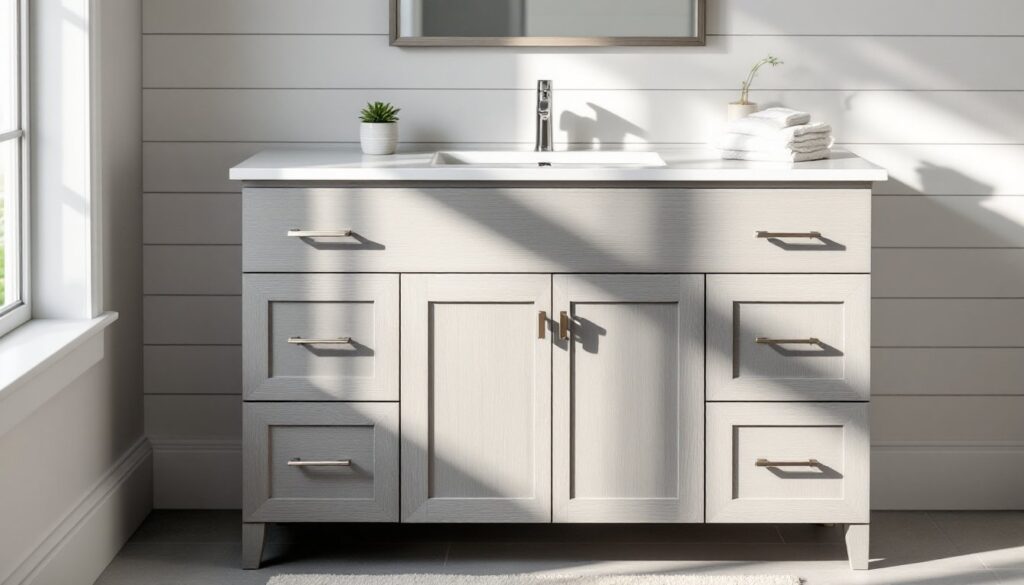
Transitional vanities blend clean lines with subtle detailing, think flat-panel doors with simple hardware and tapered legs. Finishes include gray, navy, or weathered oak. This style adapts easily to both updated older homes and new construction, and pairs well with quartz or engineered stone tops.
Modern collections emphasize slab-front drawers, integrated handles, and wall-mounted or floating configurations. Finishes are typically high-gloss white, matte black, or natural walnut. Countertops are often integrated sinks in solid surface or vessel bowls in ceramic or glass. According to design platforms like Homedit, floating vanities remain a top trend for small bathrooms because they visually open up floor space.
Most Chan’s vanities come with a choice of countertop materials: cultured marble (budget-friendly, stain-resistant), natural stone (premium look, requires sealing), or engineered quartz (low-maintenance, wide color range). Some models offer integrated sinks molded into the countertop, eliminating the rim where grime accumulates.
How to Select the Right Size and Configuration
Start by measuring your bathroom’s rough-in dimensions, the distance between existing water supply lines and the drain centerline. Standard rough-ins are 4 inches on-center for the drain and 8 inches apart for hot/cold supplies, measured from the wall.
Vanity width must account for door swing clearance and adjacent fixtures. Leave at least 21 inches of clear space in front of the vanity per International Residential Code (IRC) recommendations for comfortable use. If your bathroom is narrow, consider a wall-mounted faucet to reduce countertop depth from the standard 21-22 inches down to 18 inches.
Single-sink vanities (24″–48″) work for powder rooms and secondary baths. Double-sink vanities (60″–72″) require at least 30 inches of countertop width per sink to avoid elbow collisions during morning routines. If you’re tight on space but want two sinks, a 60-inch vanity with offset basins is the minimum functional size.
Drawer vs. door configuration affects storage efficiency. Full-height drawers maximize usable space and eliminate the awkward reach into deep cabinets, but they cost more. Traditional door cabinets with a false drawer front at the top are budget-friendly and still provide shelf storage, though you’ll lose some accessibility.
Measure your ceiling height and existing lighting before choosing a vanity with a top-mounted mirror or hutch. You want the mirror center at roughly 60-65 inches from the floor for average users, and sconces or overhead lighting should clear the mirror top by at least 3 inches.
Material Quality and Construction Features
Chan’s Furniture vanities typically use solid wood face frames and plywood cabinet boxes, a step up from the particleboard cores common in budget lines. Plywood resists moisture damage better and holds screws more securely if you ever need to adjust hinges or install additional hardware.
Look for dovetail or dowel joints in drawer boxes. Stapled or glued butt joints will loosen over time, especially in humid environments. Full-extension undermount slides let you access the entire drawer and support more weight than side-mount slides. Many Chan’s models include these as standard on all drawers, not just the top one.
Finish quality matters in bathrooms. Multi-step finishes with a top coat of catalyzed varnish or conversion varnish resist water spots and toothpaste spatter better than simple stains. If the product spec mentions low-VOC or water-based finishes, that’s a plus for indoor air quality, though it doesn’t directly affect durability.
Countertop material impacts both maintenance and longevity. Cultured marble is cast resin with a gel coat: it’s non-porous and affordable but can scratch or yellow over time. Natural granite or marble requires annual sealing to prevent stains. Engineered quartz (brands like Caesarstone or Silestone) offers the look of stone with near-zero maintenance, no sealing required. Designers on Remodelista often recommend quartz for high-use bathrooms due to its resistance to etching from acidic products.
Backsplash height varies. A 4-inch integrated backsplash is standard and protects the wall from splashes. If you’re tiling the wall, order the vanity top without a backsplash or with a low profile to avoid a seam line.
Installation Tips for Your Chan’s Furniture Vanity
Before you start, turn off water at the shutoff valves under the old vanity and drain the lines by opening the faucet. If there are no shutoffs, you’ll need to install them or shut off the main supply, this is also a good time to upgrade to quarter-turn ball valves if you have old compression valves.
Removing the old vanity:
- Disconnect the P-trap and water supply lines. Keep a bucket and rags handy for residual water.
- Cut the caulk bead along the wall and floor with a utility knife.
- Check for screws through the back rail into wall studs. Remove them before pulling the vanity away.
- Inspect the wall and floor for water damage. Now’s the time to patch drywall, replace subflooring, or add a moisture barrier if needed.
Installing the new vanity:
- Check for level front-to-back and side-to-side. Use shims under the base if the floor isn’t perfectly flat. Don’t rely on the vanity legs alone to correct an out-of-level floor.
- Locate studs and mark them. Secure the vanity with 3-inch cabinet screws through the back rail into at least two studs. If your wall is tile over cement board, use toggle bolts or masonry anchors rated for the vanity’s loaded weight.
- Set the countertop on the cabinet. Some models use a bead of silicone adhesive along the top edge: others rely on weight and a few dabs of adhesive at corners. Check the manufacturer’s instructions.
- Install the faucet and drain before setting the top if it’s a drop-in sink. For undermount sinks, the fabricator usually attaches the sink and faucet before delivery.
- Reconnect plumbing. Use new braided supply lines and a new P-trap, old ones often leak after reinstallation. Hand-tighten first, then add a quarter turn with a wrench. Over-tightening cracks fittings.
- Caulk the seams where the vanity meets the wall and floor with 100% silicone caulk (not acrylic latex). Smooth the bead with a wet finger or caulk tool.
Permit note: Replacing a vanity on existing plumbing typically doesn’t require a permit, but if you’re moving supply lines or changing drain locations, check local codes. Some jurisdictions require a licensed plumber for any drain alterations.
Maintenance and Care for Long-Lasting Beauty
Daily care is simple: wipe down the vanity with a damp microfiber cloth and dry it immediately. Avoid leaving standing water on countertops or around the sink rim, prolonged exposure to moisture can damage even well-sealed wood and cause caulk to fail.
For wood cabinets, use a pH-neutral cleaner or a mix of mild dish soap and water. Skip ammonia-based glass cleaners and abrasive scrubs: they’ll dull the finish over time. Every six months, apply a furniture polish or paste wax to the exterior to refresh the protective layer. For ideas on maintaining cabinetry finishes in high-moisture areas, Homify offers case studies from design professionals.
Countertop care depends on material:
- Cultured marble: Use non-abrasive cleaners. Buff out minor scratches with automotive polishing compound.
- Natural stone: Seal annually with a penetrating stone sealer. Blot spills immediately, acidic substances (hairspray, perfume) can etch the surface.
- Quartz: Wipe with soap and water. Avoid harsh chemicals like paint remover or oven cleaner, which can dull the resin binder.
Hardware maintenance: Tighten knobs and pulls every few months, vibration from drawer use loosens screws. If soft-close hinges start slamming, adjust the hydraulic damper screw on the hinge arm (usually a small Phillips head). Don’t force a stuck drawer: check for an object jamming the slide or a loose screw catching the drawer box.
Prevent mold and mildew by running the bathroom exhaust fan during showers and for 20 minutes afterward. Wipe down the vanity toe kick and the gap between the vanity and wall, these areas trap moisture and are often overlooked.
Inspect caulk joints annually. If you see gaps or discoloration, scrape out the old caulk with a utility knife or caulk removal tool, clean the joint with rubbing alcohol, and reapply. Fresh caulk prevents water from seeping behind the vanity and damaging the wall.
Conclusion
Chan’s Furniture bathroom vanities offer a practical middle ground between big-box budget options and custom cabinetry. Focus on construction details, plywood boxes, dovetail drawers, and quality finishes, and match the size and style to your bathroom’s layout and design. Proper installation and regular maintenance will keep the vanity looking sharp and functioning smoothly for years. Measure twice, secure it to studs, and don’t skip the caulk.