Table of Contents
ToggleAmish bedroom furniture stands apart in a market flooded with particle board and Allen wrenches. Built using traditional joinery techniques passed down through generations, these pieces are designed to last decades, not just until the next move. If you’re furnishing a bedroom and want furniture that won’t wobble after two years or require replacement screws, Amish-made pieces offer a level of durability and craftsmanship that’s increasingly rare. This guide walks through what makes Amish furniture different, how to choose the right wood and style, and where to find authentic pieces that’ll outlive most modern alternatives.
Key Takeaways
- Amish bedroom furniture uses traditional joinery techniques like mortise-and-tenon joints and wooden pegs instead of nails, creating durability that outlasts mass-produced alternatives by decades.
- Solid hardwood construction with hand-sanded finishes and no veneers or composite materials ensures that Amish furniture pieces can be refinished multiple times without losing structural integrity.
- Popular wood species for Amish bedroom sets include oak for durability and grain pattern, maple for painted finishes, cherry for natural color development, and walnut for premium options, each affecting the piece’s appearance and longevity.
- Amish bedroom furniture styles range from Mission and Shaker designs with clean lines to traditional Queen Anne with curves and contemporary pieces that blend craftsmanship with modern needs.
- Authentic Amish furniture can be purchased directly from workshops (8–16 week lead time), through regional retail showrooms, or online retailers, with pricing starting around $800–$1,200 for a basic oak queen bed.
- Proper maintenance of Amish bedroom furniture includes regular dusting, avoiding direct sunlight and extreme humidity, and annual hardware tightening to preserve the investment over a 30+ year lifespan.
What Makes Amish Bedroom Furniture Unique?
Amish furniture is built using mortise-and-tenon joinery, dovetail joints, and wooden pegs instead of nails, screws, or staples. These traditional techniques create structural integrity that metal fasteners can’t match. The wood itself moves with seasonal humidity changes, and joinery accommodates that movement without compromising stability.
Each piece is handcrafted by individual woodworkers or small workshops, not churned out on assembly lines. That means variations in grain pattern, slight differences in dimensions, and attention to details like drawer glide smoothness and door alignment. Most Amish craftsmen use solid hardwood, no veneers, laminates, or MDF cores, which adds significant weight and longevity.
The finish process typically involves hand-sanding through multiple grits (often up to 220-grit or finer) and application of catalyzed conversion varnish or natural oils. This protects the wood while letting the grain remain visible. You won’t find the plastic sheen of polyurethane sprayed over low-grade wood: the finish enhances rather than masks the material.
Amish workshops generally operate without electricity from the grid, relying on pneumatic or hydraulic power, diesel generators, or hand tools. This isn’t a gimmick, it shapes the pace and precision of the work. A craftsman can’t rush a hand-planed surface or force a tight joint. That deliberate approach translates to furniture that fits together precisely and ages well.
Popular Types of Amish Bedroom Furniture
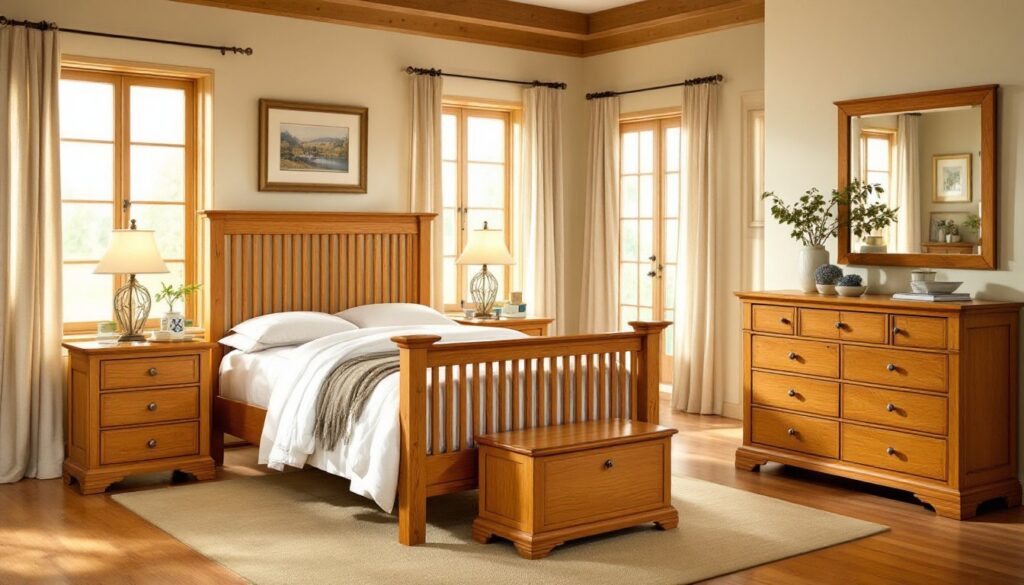
Amish furniture bedroom sets typically include a bed frame, dresser, and nightstands, though pieces are often sold individually so you can mix sizes or styles. The bed frames use solid wood slats or support rails instead of metal brackets, and headboards are often crafted from single wide boards or paneled construction with mortise-and-tenon frames.
Dressers feature dovetailed drawers, look for through-dovetails on higher-end pieces where the joints are visible on the drawer fronts, or half-blind dovetails for a cleaner face. Drawers ride on wooden glides or undermount soft-close hardware, depending on the workshop and customer preference. Traditional designs skip metal slides entirely, using waxed wood-on-wood glides that last indefinitely with minimal maintenance.
Blanket chests and armoires are common in Amish bedroom collections. Armoires solve closet space issues in older homes and often include adjustable shelves, hanging rods, and drawers. Blanket chests double as storage and seating, with lift-top lids and either bracket or bun feet.
Nightstands range from simple two-drawer designs to larger pieces with shelves or cabinet doors. Many feature inset doors and drawers, where the face sits flush with the frame, requiring precise joinery and careful fitting. This detail is a hallmark of quality cabinetry and signals a craftsman’s skill level.
Mirrors and jewelry boxes round out bedroom offerings. Mirrors are mounted in solid wood frames with traditional joinery, and jewelry boxes often include felt-lined compartments, small dovetailed drawers, and lift-out trays.
Choosing the Right Wood for Your Amish Bedroom Set
Oak (red or white) is the most common species in Amish furniture. It’s hard, durable, and has prominent grain patterns, especially red oak with its cathedral figure. White oak is slightly harder and more water-resistant, often preferred for Arts and Crafts or Mission styles where quartersawn cuts display ray fleck patterns. Oak takes stain well but can turn orange or blotchy if not prepped properly with wood conditioner.
Maple (hard maple, also called sugar maple) offers a tight, uniform grain and exceptional hardness. It’s the go-to for painted finishes because the grain doesn’t telegraph through, but it also looks clean in natural or light stains. Maple dents less than softer woods, making it a practical choice for kids’ bedroom furniture projects or high-use pieces.
Cherry starts out a light pinkish-tan and darkens to a deep reddish-brown over years of UV exposure. It’s a medium-hardness wood with a fine, straight grain and excellent workability. Cherry develops a rich patina that many buyers prize, but if you want consistency, be aware that color will shift significantly over the first few years. It’s often clear-coated rather than stained to let the natural color develop.
Walnut is the premium option, dark, rich, and naturally resistant to warping. It’s softer than oak or maple but machines beautifully and rarely needs stain. Walnut’s color ranges from chocolate to purplish-brown, with dramatic sapwood streaks if you choose character-grade boards. It’s more expensive and less common in budget lines.
Hickory and elm show up in rustic or reclaimed-look collections. Hickory has wild grain variation and color contrast between heartwood and sapwood. Elm has interlocking grain that resists splitting, though it’s less available since Dutch elm disease reduced supply decades ago.
Wood selection affects weight, color, and how the piece ages. Oak and maple are workhorse species suitable for most settings, while cherry and walnut lean toward formal or traditional interiors.
Amish Furniture Styles: From Mission to Shaker
Mission (or Arts and Crafts) style emphasizes straight lines, exposed joinery, and quartersawn oak. Look for through-tenons on bed posts, slatted headboards, and minimal ornamentation. The design aesthetic grew out of early 1900s rejection of Victorian excess, and Amish craftsmen adopted it naturally, it aligns with plain, functional values.
Shaker furniture strips detail down further: tapered legs, simple knobs, and no applied decoration. Shaker pieces often use poplar or pine painted in traditional milk paint colors (reds, blues, greens), though hardwood versions in natural finishes are also built. The emphasis is on proportion and utility, every element serves a purpose. Shaker-style bedroom sets suit minimalist or farmhouse interiors where clean lines dominate.
Traditional or Queen Anne Amish furniture incorporates more curves, cabriole legs, arched aprons, raised panel doors. This style requires more handwork and shaping, so it’s often priced higher. It fits formal bedroom layouts and pairs with classic bedding and window treatments.
Rustic or reclaimed styles use distressed finishes, live-edge slabs, and mixed wood tones. Some workshops source barn wood or salvaged lumber, planing it smooth but leaving natural imperfections like nail holes, checking, or color variation. This style works well in cabins, modern country homes, or industrial lofts where texture and history add character.
Contemporary Amish designs blend traditional joinery with modern proportions, lower profile beds, streamlined case goods, and integrated lighting or charging stations. These pieces prove that Amish craftsmanship isn’t locked in the past: it adapts to current needs without sacrificing build quality.
How to Care for and Maintain Amish Bedroom Furniture
Dust regularly with a microfiber cloth, avoid feather dusters that just move particles around. For deeper cleaning, use a barely damp cloth and dry immediately. Water left on wood finishes can cause white rings or cloudiness, especially on catalyzed varnish.
Every 6–12 months, apply a furniture polish or conditioner appropriate to the finish type. For oil finishes (tung oil, linseed oil, Danish oil), use a compatible oil and buff off excess. For varnish or lacquer finishes, use a paste wax or commercial polish without silicone, silicone builds up and interferes with future refinishing.
Avoid placing furniture near heating vents, radiators, or in direct sunlight. Solid wood expands and contracts with humidity changes, and extreme or rapid shifts can cause joints to loosen or panels to crack. If you live in a dry climate or heat with forced air, run a humidifier during winter months to keep indoor humidity between 35–45%.
Tighten hardware annually. Even the best joinery can develop slight play over time, especially on drawers or doors. Use a screwdriver or Allen wrench to snug up hinges, knobs, and any metal brackets. If a joint loosens and you can’t tighten a fastener, don’t force it, contact the maker or a furniture repair specialist. Forcing a loose tenon can split the surrounding wood.
For scratches or dings, use a touch-up marker or wax stick that matches the finish color. Deeper gouges may need sanding and spot refinishing, which is best left to a professional unless you have experience with wood finishing. The beauty of solid wood furniture is that it can be refinished multiple times without losing structural integrity, unlike veneer pieces that sand through to substrate.
Where to Buy Authentic Amish Bedroom Furniture
Amish made bedroom furniture is sold through several channels, each with tradeoffs. Direct purchase from Amish workshops in Ohio, Pennsylvania, or Indiana offers the best pricing and customization options. You can specify wood species, stain color, hardware, and dimensions. Expect lead times of 8–16 weeks depending on the shop’s backlog and complexity of the order. Some workshops accept phone or mail orders but don’t maintain websites or take credit cards, check local directories or community contacts.
Retail showrooms in Amish regions act as intermediaries, displaying sample pieces and coordinating orders with multiple workshops. They handle logistics, payment processing, and shipping, charging a markup for the service. This route simplifies the process if you’re not local and want to compare styles or builders in one location.
Online retailers and specialty stores ship nationwide. Verify that the furniture is genuinely Amish-made, some retailers use “Amish-style” language to describe imported or factory pieces that mimic the aesthetic but lack the joinery and materials. Look for clear disclosure of wood species, joinery methods, and builder location. Authentic pieces will always be solid wood, never veneer or composite.
Delivery and setup are critical for large bedroom sets. Professional delivery services will uncrate, assemble (if needed), and place furniture. For out-of-state orders, freight shipping to a terminal is cheaper but requires you to arrange final transport and unloading, beds and dressers are heavy, often 150–300 pounds each, and awkward to maneuver.
Pricing for amish furniture bedroom sets varies widely based on wood, finish, and design complexity. A basic queen bed in oak might start around $800–$1,200, while a full cherry bedroom set (bed, dresser, two nightstands) can run $4,000–$8,000 or more. That’s a significant upfront cost, but when spread over a 30+ year lifespan, it’s often comparable to replacing cheaper furniture every 5–7 years.
Conclusion
Amish bedroom furniture isn’t a shortcut or a trend. It’s an investment in pieces built to last through moves, kids, and decades of daily use. The joinery, materials, and finish quality separate these pieces from anything you’ll find in big-box stores. If you value furniture that can be repaired rather than replaced and ages into something better rather than worse, Amish craftsmanship delivers. Measure your space, choose your wood and style, and plan for lead time, you’re not ordering off a shelf, you’re commissioning work from a tradition that’s been refining its methods for over a century.